In the quiet suburbs of Michigan, where life is usually measured by high school football scores and the availability of sprinkles at the local donut shop, my world was once defined by a vibrant, living warmth. My mother, Sarah, was a woman who seemed to carry a gentle light within her, a soft steady courage that remained even after she was diagnosed with cancer when I was eleven. Among the many things people remembered about her, it was her scarves that stood as her most enduring signature. She owned silk ones with floral prints, chunky knitted wraps for winter, and soft pastels for spring. To her, they weren’t just accessories; they were moods. Even through the grueling months of chemotherapy, she eschewed wigs for those scarves, tying them in elaborate, beautiful knots that served as a reminder that she was still present, still radiant, and still herself.
When she passed away, those scarves were gathered into a floral box with pink hydrangeas on the lid and placed on a high shelf in my closet. They were my sanctuary. On the days when the silence of the house became too heavy, I would take the box down and let the lingering scent of jasmine and vanilla fill my chest until the ache felt almost like a hug. For three years, it was just my father and me navigating the wreckage of our grief. He was a man of quiet industry, burying himself in work and home repairs to avoid the stillness. Then, he met Valerie.
Valerie was a woman of finance and beige aesthetics. She was soft-spoken and perpetually neat, smelling of powder and citrus. At first, her presence seemed benign, but soon a subtle chill began to permeate our home. She had a surgical way of removing “clutter,” which inevitably meant the erasure of my mother’s memory. Photos disappeared from counters; a favorite chipped mug was replaced by something sleek and characterless. Valerie’s philosophy was clinical: “Focus on what’s ahead, Emma, not what’s gone.” I learned to grieve in the shadows, keeping my box of scarves hidden behind winter sweaters like a forbidden treasure.
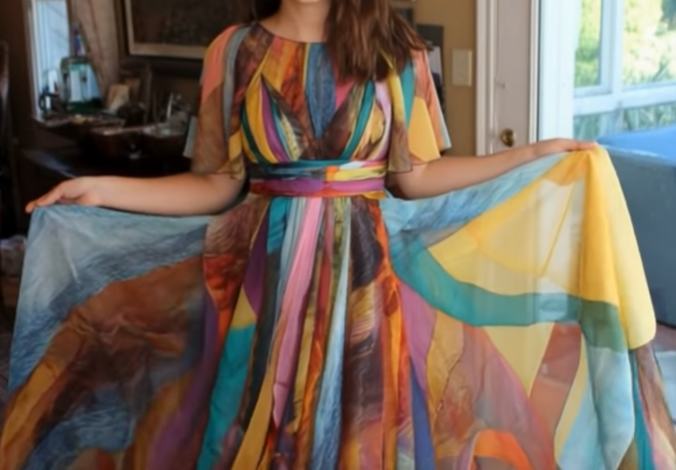
As my senior year approached, the fervor of prom season took over the school. While other girls were obsessed with sequins and designer labels, a quiet idea took root in my heart. I decided to sew my own dress using the fabric of my mother’s scarves. It felt like a sacred project. For two weeks, I retreated to my room after school, meticulously piecing together the yellow silk she wore to church, the turquoise cotton from my twelfth birthday, and the deep red wrap my father gave her for their final Christmas. As the needle passed through the fabric, I felt as though I were stitching my mother into the present moment. The resulting gown was a shimmer of memories—a swirl of color that felt like a masterpiece of the heart.
Prom morning arrived with a sense of peace I hadn’t felt in years. I curled my hair just as Mom used to and wore the gold locket she gave me for my tenth birthday. I felt ready to face the world. However, when I opened my closet door to retrieve the dress, the world fractured. The gown was gone. In its place, on the floor, was a graveyard of fabric. Yellow, turquoise, and red silk lay in shredded, limp scraps. My breath caught in my throat as my knees hit the carpet. I was frantically trying to gather the pieces when I heard the sharp, rhythmic click of heels behind me.
Valerie stood in the doorway, her coffee mug in hand, looking at the wreckage with terrifying composure. “You’re welcome,” she said, her voice devoid of any edge. She claimed she was “saving” me from humiliation, referring to my mother’s cherished belongings as “rags” that should have been trashed years ago. The cruelty was so casual that it left me breathless. But then, the silence was broken by my father. He stood behind her, having witnessed the aftermath and heard her callous justification.
For the first time in my life, I saw my father’s grief turn into a searing, protective rage. He didn’t just see a ruined dress; he saw the desecration of the woman he had loved. He told Valerie she had no right—none at all—and ordered her to pack her things and leave that very night. In that moment, the weight of being the “quiet one” fell away from me. As my father knelt beside me, picking up a torn red scarf with trembling hands, I realized I wasn’t alone in my sorrow anymore.
Driven by a need to be anywhere but that house, I took the pile of scraps to school and sought out Mrs. Henderson, our textiles teacher. With the patience of an artisan and the empathy of a friend, she sat with me for hours in the art room. We treated the frayed edges like sacred artifacts. We couldn’t restore the dress to its original state, but we could create something new from the ruins. Every tear was curved into a new seam; every frayed thread was reinforced. The yellow panel became a heart-shaped bodice; the red silk was lined with sturdier fabric. When we were finished, the dress was different—it bore the scars of its destruction—but it was beautiful in a way that was deeper and more resilient than before.
That night, I stood before the mirror. The dress was a patchwork of survival. Its uneven seams and mismatched stitches told a story of a love that refused to be discarded. When I walked into the prom, there was no judgment or mockery. Instead, my peers saw a painting come to life. Savannah, a girl I barely knew, told me it looked like the dress told a story. I smiled, knowing it told the story of a mother’s warmth and a daughter’s refusal to let go.
The true resolution, however, came when I returned home. The porch light was off, and the house felt strangely light. Inside, the absence of Valerie was a physical relief. Her impersonal art and citrus scent were gone, and the hallways felt vast and welcoming again. My father met me at the door, and for a long time, we just looked at each other. He told me I looked exactly like my mother did the day they met. We stood in the moonlight of our foyer, looking at the patched dress hanging on the hook. It wasn’t perfect, but it was real. We had stitched our lives back together, moment by moment, just like the fabric. The house was no longer a place of shadows; it was finally, once again, a home.
