My name is Ilana Cross. I’m the second daughter—the one who always knew how to smile quietly, blend in politely, and be forgotten without anyone having to say it out loud.
I showed up to my sister Kalista’s birthday party the way I’ve shown up my entire life: on time, dressed appropriately, carrying a thoughtful gift, and not expecting much. And still, somehow, it wasn’t enough.
They had me seated by the cooler, next to the trash bags. The kind of placement you give to someone you only half-remembered inviting. No name tag, no “hello” from my parents, just tight smiles and the sharp clang of wine glasses clinking for someone else’s toast.
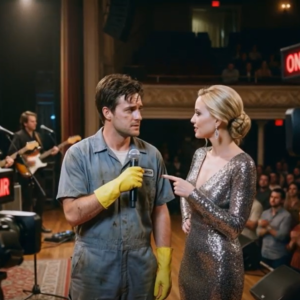
Then came Kalista’s moment. Microphone in hand, sequins flashing under the fairy lights, she raised her glass and toasted herself like a queen addressing loyal subjects. And right before she sat it down, she added with a smirk, “Let’s not forget my baby sister, Ilana, who’s always been great at folding chairs.”
They laughed. Everyone. Even my father chuckled like it was harmless.
I didn’t laugh. I smiled, the way you do when you’re bleeding pride behind your teeth.
But let me ask you something. What happens when the woman they all dismissed turns out to be the one who signs their paychecks? What happens when the useless sister is the one who owns everything they brag about?
Stay with me. Let me show you what happened before I said the words that silenced an entire backyard.
I stayed seated near the cooler, where the condensation from the water bottles soaked through the plastic tablecloth and dampened my sleeve. No one noticed. No one asked me to move.
Across the yard, Kalista floated from group to group, soaking up compliments like sunlight. Her laughter was rehearsed and polished. The gold “Birthday Queen” sash hugged her waist like it had been designed just for her. Maybe it had.
The backyard was a curated performance. White and gold linen on every table, champagne towers, a live string quartet in the corner. It looked like a spread from a lifestyle magazine. And yet, somehow, I was still seated where I could smell the plastic of the lawn chairs and the lemons from the garbage bags. That’s where they’d put me: on the outskirts of elegance.
A woman in a sleek jumpsuit leaned down beside me. “Aren’t you Kalista’s assistant or something?” she asked, squinting.
I gave her a polite nod and turned back to my glass. I didn’t correct her.
This wasn’t new. This wasn’t unique to tonight. This was just the latest installment in a long, ongoing saga of quiet exclusions and swallowed pride. I’d been sidelined my whole life, disguised as “practical,” “dependable,” the one who didn’t need attention.
I looked across the lawn and saw the photo display. A golden string held dozens of framed memories: Kalista’s ballet recital, her college graduation, her wedding, even her first marketing award.
There wasn’t a single photo of me. Not one. It was as if I’d never been born.
Sometimes I used to wonder if I’d been adopted, if some clerical error in the hospital had landed me in the wrong family. That’s how far removed I’d always felt. I wasn’t rebellious. I wasn’t difficult. I was just invisible, the kind of child you only notice when they’re not around to take out the trash.
I remember when I was 12 and Kalista had her ballet recital. It was the same day as my birthday. My mother decided we’d “combine the celebrations.” What that meant was Kalista got applause; I got a shared cake. She twirled in ivory tulle while I stood in a hand-me-down lavender dress that smelled faintly of mothballs. Everyone complimented her grace. No one asked why my dress dragged awkwardly on the floor.
When it was time for the group photo, I stood next to her, hoping for a moment of acknowledgement. My mother frowned. “Honey, can you move to the side? The lighting’s better without you blocking it.”
She didn’t see how long I stood there afterward, pretending to admire the dessert table, pretending not to blink too fast.
That wasn’t the last time. In high school, Kalista got tutoring and weekend dance workshops. I got told to vacuum the living room and stop asking for rides. At 18, she was given a new Jeep with a red bow. I got a graduation card that read, “We hope you find your path soon.”
I did find my path. They just never looked far enough to see it.
Back in the present, I watched as Kalista’s co-workers raised glasses and toasted to her “visionary leadership.” One man even called her the “golden girl” of the marketing division. I nearly laughed. She wasn’t even the one who led that campaign. But it didn’t matter. She looked the part. That was always enough.
A server walked by with a tray of mini crab cakes. I took one and thanked her. She looked surprised, then smiled gently. Probably the first “thank you” she’d gotten all night.
It’s strange how you can stand in the middle of people who know your name and still feel completely invisible.
Even as an adult, I held on to this quiet hope that if I accomplished enough, if I succeeded without asking for anything, they’d notice. That one day, I’d walk into a room and someone in my family would finally see me. Not for how helpful I could be, not for how quiet I stayed, but for who I actually was.
That moment had never come. Until tonight.
I shifted in my seat, the metal legs creaking beneath me. For a moment, I let myself feel it. The quiet ache that had followed me for three decades. Not just the ache of being overlooked, but the ache of knowing they never once wondered what I might have been building in the dark.
Because I had been building something. Quietly. Carefully. Strategically. Not for them, not to be seen, but because I knew one day the masks would fall, and the truth would stand uninvited at the center of their curated world.
A few seats away, my mother threw her head back in laughter, probably at another story about Kalista’s first ballet trophy. My father stood beside her, nursing a plastic cup of white wine, nodding like he still believed being proud was his birthright.
They’d always believed I worked a small admin job, answering phones somewhere, living modestly because I lacked ambition. That’s the story they repeated. It was easier to reduce me to a category than to ask what I was really doing with my time.
What I was doing was buying things. Companies. Assets. Leverage.
Seven years ago, I took my first controlling interest in a Chicago logistics firm. Then a struggling content distribution company. Then a shell corp to absorb shares in a national marketing agency.
That last one… it’s where Kalista works now.
I didn’t fire her. I didn’t even change her job title. I just watched. I restructured her department from afar, approved the marketing budgets, and reviewed the performance metrics she took credit for. The campaign success they toasted earlier tonight? I had declined that proposal for duplication risk. Her manager repackaged it, it floated upward, and landed on my desk. I sent it back with a note: Declined. Lacks originality. Flag for discussion on ethical sourcing. Her division never knew it was me.
I preferred it that way. Real power doesn’t shout. It watches. It waits. It moves pieces until the board belongs to you.
“Ilana, you’re too serious,” my father once said. “You take everything so personally.”
No. I take things precisely.
My fingers traced the rim of my wine glass, cool and slick with condensation. I thought of the old slideshow from my grandmother’s anniversary party, the one where they forgot to include a single photo of me. My mother had smiled brightly and said, “I didn’t want to make it too long.” I remember sitting between cousins, holding a paper plate of cold chicken, waiting for an image of myself that never came.
That’s when I learned you can vanish from your own story if you stay quiet long enough.
But not tonight.
A girl in a black server uniform passed by with a tray of desserts. Young, maybe 20. She paused just slightly, her eyes catching mine. Then, in a near-whisper, she said, “I know who you are.”
I blinked. “I’m sorry?”
She straightened a little, still holding the tray. “The VJ Grant. Two years ago. I was one of the recipients. Thank you, ma’am.”
“Ma’am.” She didn’t smile. She didn’t wait for acknowledgement. She simply nodded once, then walked away.
It hit me harder than Kalista’s toast. Someone in this crowd knew. Not the version they wrote me into, but me. The real me. And she wasn’t the only one.
Across the lawn, Kalista posed under string lights with two co-workers. One of them was a junior associate I’d personally kept during layoffs. Her numbers were average, but her potential was real. I’d made that call from the other side of the org chart. She never knew.
Someone at the dessert table tilted their head in my direction. Another leaned in to whisper. A ripple, almost imperceptible, moved through the group. It wasn’t panic, not yet. But it was awareness. The current had shifted.
Then Marcus arrived.
I heard the soft hum of tires on gravel before I saw him. A sleek black Tesla eased to a stop near the front gate. When the door opened, Marcus Lang—the CEO of the parent group Kalista thought she’d one day run—stepped out in a navy suit and mirrored sunglasses.
Kalista gasped. “That’s my boss,” she whispered to someone nearby, smoothing her hair. “Oh my god, what is he doing here?”
I didn’t move.
He walked through the yard with calm precision, past the champagne tower, past the cornhole game, past Kalista. He didn’t break stride. He didn’t acknowledge her at all.
He stopped two feet from me.
“Madam Cross,” he said quietly, removing his sunglasses. “Wasn’t expecting to see you here.”
Not Ilana. Not “Miss.” Madam. And with it, the air around us changed. Kalista’s smile faltered.
“I wasn’t expecting you either, Marcus,” I said evenly. My voice didn’t rise. It didn’t need to.
He glanced toward the patio, then leaned slightly closer. “Do you need a ride after this? I need to brief you on the Morgan acquisition. They’ll fold if we play this right.”
I nodded once. “I’ll find you later.”
He offered a small nod of respect and moved on, calm, unfazed, leaving a trail of confusion in his wake. Kalista stared at me, her champagne flute trembling slightly. Someone behind her murmured, “Did he say… Cross?”
And just like that, the useless sister became someone they had never really seen.
Kalista blinked, her face frozen somewhere between confusion and disbelief. Around her, the party didn’t stop, but it stumbled. Laughter quieted. Conversations shifted to murmurs. She turned toward me like she just remembered I existed, but not in the way she used to. This time, there was calculation behind her gaze.
I didn’t flinch. Instead, I picked up my clutch, stepped away from the cooler, and walked calmly across the patio. I wasn’t headed for confrontation. I was headed for clarity.
My father intercepted me near the dessert table, a burger in one hand. “Well, look who’s still playing secretary,” he said, glancing at my flats. “Kalista says you’re… what was the word? ‘Comfortable.’ Comfortable in your little role.”
I tilted my head.
He bit into the burger. “You know, I helped your cousin get a grant last year. Used your LLC. Women-owned, looks good on paper.”
I blinked once. “You used my business name for a grant?”
“Relax,” he laughed. “You weren’t using it. It was for family.”
No apology. Not even awareness. “You used my identity,” I said quietly.
“You always were sensitive,” he muttered. “That’s why people overlook you.”
I leaned in slightly. “I don’t get overlooked. You choose not to see me.” Then I walked past him, slow, deliberate, unshaken.
Kalista’s voice rang out again near the fountain, retelling the campaign story. “They said I ‘think like a CEO’!” she laughed.
Yes, I remembered that campaign. Risky, unoriginal. I’d declined it. Her version was just repackaged, still hollow, and now she was building her rise on it.
I stood by the drink table. My mother clutched her pearls. My aunt smiled.
Marcus stepped beside me. “Do you want to do it now?” he asked quietly.
I shook my head. “Just one moment.”
I walked to the long serving table and placed a thick manila envelope on the white linen. Kalista’s eyes locked on it. “What’s that?” she asked, her voice still laced with false brightness.
I didn’t raise my voice. “Proof,” I said.
She stepped closer. I didn’t open the envelope. I didn’t need to. She knew. Her hand twitched. “You think this makes you better than me?”
“No,” I said. “It makes me honest.”
She scoffed. “You’re just jealous.”
I smiled slightly for the first time all night. “Then why are you the one trembling?”
She stepped forward like she wanted to lunge, but the crowd was watching. Not just watching—re-evaluating. The useless sister wasn’t useless. She was standing in full light, and Kalista’s grip on the narrative was slipping fast.
Marcus cleared his throat. “Thank you for signing off on the transfer, Madam Cross. It’s official.”
Kalista snapped toward him. “Transfer?”
I nodded once. “You’ll be moving to the Tempe office. Smaller team, fewer spotlights. A good place to reflect.”
Silence bloomed around us, wide and weighty. Someone coughed. My mother sat down hard on a nearby chair, her face pale.
I stepped forward just enough for my voice to carry. “Every time you called me too quiet,” I said, “I was building something you couldn’t see. And while you were making jokes…” I paused. “I was signing checks.”
Then I turned and walked away. I didn’t need their toast. I didn’t need their chairs. The crowd didn’t gasp, but they didn’t laugh either. And that was enough.
I left the manila envelope where it was, beside the deviled eggs and broken illusions. I wasn’t there to humiliate anyone. I just wanted the lying to stop.
As I walked back toward the edge of the lawn, I passed the folding chair by the cooler, the one they’d saved for me. It was still there, still ugly, still a message. But I didn’t even glance at it this time. I walked right past it. It didn’t matter.
Behind me, the party stuttered. My father stood stiff, staring at the envelope. My mother clutched her arms around herself. Kalista didn’t say another word.
And then I heard it. A soft clink of a glass being set down. Then another. Someone murmured, “I always knew she was the smart one.”
I didn’t turn around.
Three days passed. No texts, no apologies, no recycled excuses, just silence. But this time, it didn’t hurt. This time, it felt like peace.
Monday morning, I was in the office before my assistant finished her latte. “Good morning, Ilana,” she smiled, placing a folder on my desk. “The Morgan acquisition call is at 10. Your team is prepped.”
I nodded, slipping on my reading glasses.
Later that day, during our quarterly meeting, a young intern pulled out a chair beside the window. “Would you like to sit here, Ms. Cross?” he asked.
It reminded me too much of the plastic one near the cooler. I stepped past it and gently pulled out the chair at the head of the table.
“I think I’ve earned this one,” I said softly.
He didn’t laugh. He just nodded and helped me adjust it.
That afternoon, Marcus stopped by my office. “Kalista resigned,” he said, leaning against the door frame. “Said there was a ‘misalignment in leadership values.’” He smirked.
I didn’t react. “I never wanted to ruin her,” I said. “I just wanted the truth to matter.”
“It does,” he replied. “Because you made it.”
Before he left, my assistant brought in a small envelope. No return address. Inside was a folded card. Thank you for seeing someone like me. You gave me hope. -R.
It was from the young server, the one who whispered, “Ma’am,” while the rest of the room whispered judgment. I tucked it into my drawer.
Weeks later, at a cousin’s wedding, I saw my name printed in gold beside my mother’s on a front-row seat. I walked past it, found a quieter spot by the window—not because I was bitter, but because I had built my own table.
I finally understood. You don’t need their chair when you’ve built the entire room.