The silence in the Mitchell estate wasn’t peaceful; it was heavy. It was the specific, suffocating density of air that exists right before a thunderstorm breaks, or perhaps, the silence that settles after a casket is lowered. It was 2:47 PM on a Tuesday, and I, James Mitchell, the so-called titan behind Mitchell Pharmaceuticals, was supposed to be sitting in a climate-controlled boardroom in Manhattan. I was scheduled to close a merger that would redefine the biotechnology landscape for the next decade.
But I wasn’t in Manhattan. I was gripping the leather steering wheel of my black Bentley, doing ninety on the I-95, driven by a nausea that had nothing to do with illness. It was a cold, tightening knot in my stomach—a father’s intuition that I had suppressed with work and whiskey for far too long.
I told myself I just wanted to surprise them. I wanted to see Victoria, my stunning new wife, and my two children. I wanted to believe the lies I told myself: that the shadows under my five-year-old daughter Charlotte’s eyes were just grief for her late mother, Sarah. That her silence was just a phase. But as the iron gates of my estate swung open, I knew I was lying.
I stepped into the foyer. The house was a masterpiece of Italian marble and imported silk, designed to impress guests who didn’t actually care about us. But today, with the afternoon sun filtering through the dust motes, it felt like a mausoleum. A tomb for the living.
“Victoria?” I called out. My voice echoed, bouncing off the cold walls. Silence.
“Mrs. Chen?” No answer. That was wrong. The housekeeper never left before five. The knot in my stomach pulled tighter, turning into a lead weight.
Then, I heard it. It wasn’t a scream. A scream implies hope—a belief that someone might hear you. This was worse. It was the soft, muffled whimper of a child trying desperately to be invisible. It was the sound of a spirit being crushed.
I followed the sound past the grand staircase, down the hallway to the guest wing—a part of the house we rarely used. The door to the guest bathroom was ajar. I pushed it open, and in that split second, the axis of my world tilted and shattered.
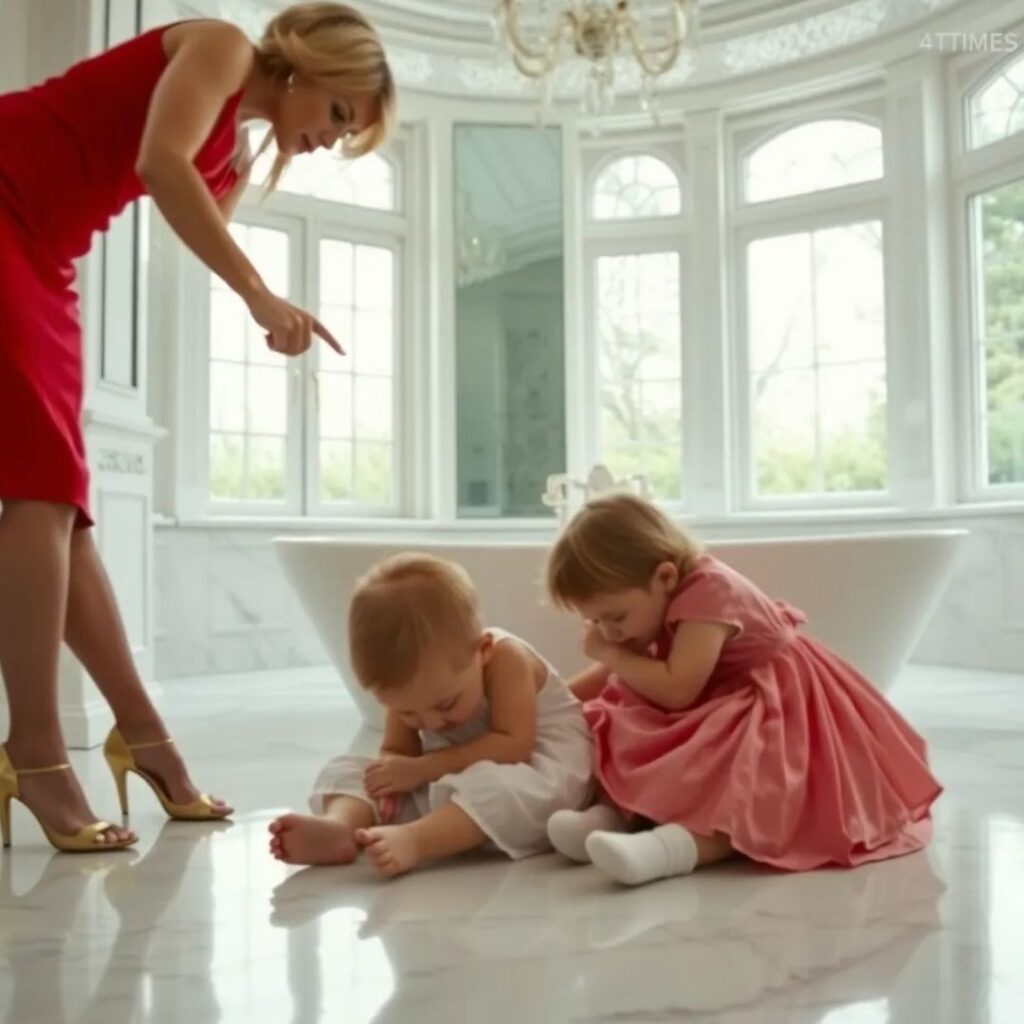
Victoria stood there. She was wearing a crimson Valentino dress, looking like a queen, but the expression on her face was something primal and grotesque.
“Scrub it, you little parasite,” she hissed. Her voice, usually a melodic lilt that charmed donors at charity galas, was now pure, concentrated venom. “If I see a single spot, you’re sleeping in the cellar.”
My eyes drifted down, and my breath stopped.
On the freezing cold tile, my daughter Charlotte was kneeling in a puddle of gray, chemically pungent water. She was five years old, wearing a faded dress two sizes too small that I didn’t recognize. Her tiny, trembling arm was wrapped protectively around her three-year-old brother, Thomas, who was sobbing silently into the crook of her neck.
With her free hand—skin raw, red, and peeling from harsh chemicals—Charlotte was scrubbing the grout with a brush that looked bigger than her forearm.
“Please,” Charlotte whispered, her voice cracking. “My arms hurt, Victoria. I can’t hold Tommy anymore. He’s heavy.”
“Then maybe you shouldn’t be such a burden to this family,” Victoria sneered. She raised a manicured hand, not to strike, but to threaten—a psychological blow. “Do you want to go back to the dark room?”
“What the hell is going on here?”
My voice didn’t sound like my own. It hit the room like a physical blow, low and vibrating with a rage I didn’t know I possessed.
Victoria spun around. The transformation was terrifyingly instantaneous. The sneer vanished, her features softened, and tears—manufactured on demand—welled up in her eyes.
“James! Oh, thank God! I… I didn’t know what to do! I came in and found them playing with the cleaning supplies… Charlotte has been so uncontrollable today, she spilled the bucket on herself…”
I didn’t look at her. I couldn’t. If I looked at her, I would have done something that would send me to prison. Instead, I looked at Charlotte.
She didn’t run to me. She didn’t cry out, “Daddy!”
She flinched.
She pulled Thomas tighter, shielding him from me.
That flinch broke me into a thousand pieces. It was a verdict on my failure as a father, more damning than any judge could deliver.
“Get away from them,” I said. The voice was a growl, unrecognizable. I walked into the room, ruining my Italian leather shoes in the chemical puddle, and knelt.
“No, no, daddy, I’m cleaning it, I promise!” Charlotte panicked, shielding her face.
“You didn’t do anything wrong.” I choked out the words, smelling the bleach on her hair—hair that should have smelled of strawberry shampoo. I scooped both of them up. They felt so light. Too light.
“I gave Mrs. Chen the day off so we could have family time!” Victoria cried, following me into the hall, desperate to regain the narrative. “James, you have to listen to me. Charlotte is mentally unstable, just like her mother was at the end!”
I stopped. I looked at the bruises on Thomas’s upper arm. They were fingerprints. Adult fingerprints.
I turned to Victoria. “Get out of my house. Now. If you are still here in ten minutes, I will have security throw you out the window.”
“You’ll regret this!” Victoria shrieked, the mask falling away completely, revealing the predator underneath. “I’m your wife! The prenup guarantees me half! No judge will believe a traumatized five-year-old over me!”
The front door slammed moments later, shaking the very foundations of the house. I sat on the floor of the hallway, holding my children, rocking them back and forth. Charlotte looked up at me. She had Sarah’s eyes—green, intelligent, and currently filled with a terror that no child should know.
“Daddy,” she whispered, her voice barely audible. “She said if I told, she’d hurt Tommy like she hurt Mommy. It wasn’t an accident.”
My blood ran cold. “What do you mean, Charlie?”
She swallowed hard, her eyes locking onto mine with an intensity that scared me. “I remember, Daddy. I remember the sound. I remember what she did to the car.”
I didn’t sleep. Sleep was a luxury for men who hadn’t let a monster live under their roof. I sat for six hours watching my children breathe, terrified that if I closed my eyes, they might shatter like fine china. By morning, I had transformed the library into a command center.
Robert Hayes, my head of security and a former Navy SEAL, stood by the mahogany desk. His face was grim as he played the hidden kitchen footage that Mrs. Chen, bless her soul, had secretly installed weeks ago because she “had a bad feeling.”
I watched in horror on the high-definition screen. I saw Victoria dragging Charlotte by her hair across the kitchen floor to clean up a broken glass. I saw her denying Thomas food because he cried.
“There’s more,” Robert said, his voice tight. He played an audio recording. Victoria was on the phone, pacing the patio.
“Two more years, Derek. The prenup expires. I’ll dump the old fool, take half the company shares, and put the brats in a boarding school in Switzerland. Sarah’s ghost is the best thing that ever happened to me. The grieving widower was such an easy target.”
The rage in me wasn’t hot; it was a cold, arctic wind. It settled in my marrow. But I needed to understand Charlotte’s claim about the accident.
I called Dr. Rachel Foster, the best specialist in childhood trauma on the East Coast. She arrived within the hour. After two hours alone with Charlotte in the playroom, Dr. Foster emerged. She looked pale, stunned.
“James,” she said, removing her glasses. “I’ve tested her. I asked her about random dates from the last two years. She knows the weather on March 3rd last year. She knows what you were wearing on Christmas Eve two years ago. She quoted a conversation she overheard between the gardening staff verbatim.”
“What are you saying?” I asked, pouring her a glass of water.
“Your daughter has Hyperthymesia. Highly Superior Autobiographical Memory (HSAM),” Dr. Foster explained, her voice trembling slightly. “It’s incredibly rare. She doesn’t just remember; she records. Every date, every sensation, every word spoken. Her brain is a 4K video archive of her entire life. She cannot forget, James. Even if she wants to.”
I felt the weight of that. It wasn’t just a gift; it was a burden. A curse.
I brought in Detective Marcus Chen. Charlotte sat on the oversized leather couch, clutching a stuffed rabbit that smelled of dust. She looked small, but her eyes were old.
“It was April 12th,” she began, her voice monotone, precise, devoid of the childish cadence she should have had. “A Thursday. 8:37 PM. Victoria was in the garage. She told Mommy: ‘Accidents happen on these winding roads, Sarah.’”
The Detective was scribbling furiously. “Go on, Charlotte.”
“The next morning, at 6:15 AM, Victoria went back. She opened the hood of the silver SUV. She had a sharp wrench. It was blue. She did something to the black tube near the engine block. The brake line.”
“I told the policeman at the scene,” Charlotte whispered, a tear finally escaping. “He gave me a sticker. He told me I was just sad and confused. He didn’t listen.”
I closed my eyes, fighting the urge to scream. My wife hadn’t lost control of the car. She had been murdered, and my daughter had been holding the evidence in her head for a year, unheard.
“I know where the tool is,” Charlotte added, breaking the silence. “Victoria didn’t throw it away. She hid it in Mommy’s old red toolbox in the shed. She told Derek on the phone it was her ‘insurance’ in case she ever needed to frame someone.”
We went to the shed. Robert pried open the rusted red box.
There it was. A specialized line-cutter, nestled under a tray of screws. And wrapped around the handle, caught in the grease, was a single, long strand of Victoria’s platinum-blonde hair.
The Detective bagged the evidence. “Mr. Mitchell,” he said, “We have enough to arrest her for murder.”
“No,” I said, staring at the tool that had killed my wife. “She’s not just a murderer. She’s a virus. If we arrest her now, she’ll fight it with lawyers. She’ll destroy my company’s reputation to save herself. We need to catch her doing something she can’t buy her way out of.”
Just then, my phone buzzed. It was my CTO.
“James,” he yelled. “Someone is accessing the mainframe. They’re downloading the Leukemia trial data. The encryption is being stripped.”
Victoria knew we were coming. She was burning the kingdom down.
Victoria wasn’t just a murderer; she was an industrial saboteur. She knew that destroying Mitchell Pharmaceuticals was the only way to hurt me if she couldn’t have my money.
“Let it burn,” I told Robert, grabbing my keys. “Trace her location.”
“She’s moving fast. Heading towards New Jersey,” Robert said, checking his tablet.
Charlotte, standing by the door, spoke up. Her voice was hauntingly calm. “Derek mentioned a private hangar at Teterboro Airport. Hangar 14. He said, ‘If things go south, the Gulfstream is always fueled.’”
The chase was a blur of sirens and rain. I drove like a man possessed, the Detective and Robert following in the security SUV.
We crashed through the chain-link gate of the airfield just as the engines of a sleek Gulfstream G650 began to whine. The noise was deafening.
Victoria stood at the top of the jet’s mobile stairs, a white trench coat fluttering violently in the wind. She looked like a fallen angel, beautiful and destructive. She saw us and stopped. In her hand, she held a smartphone over the railing—suspended above the concrete tarmac.
“Stop right there!” she screamed. Her voice was hysterical, barely audible over the jet engines. “I have the master encryption keys! One button, James! One button and I delete twenty years of research! The leukemia trials—gone! The cure for thousands of children—deleted!”
The police cars screeched to a halt, forming a semi-circle. Snipers took positions. But they couldn’t shoot. If she dropped the phone or pressed the button, billions of dollars and countless lives would be lost.
I stepped out of my car. The rain soaked me instantly. I walked toward the plane.
“Don’t come any closer!” she shrieked. “I want a flight plan approved! I want immunity!”
I kept walking. I looked into her eyes and saw the fear. She was a bully who had finally run out of victims.
“Do it,” I said. My voice wasn’t loud, but in the sudden lull of the wind, it carried.
Victoria blinked, confused. “What?”
“Delete it all,” I yelled, spreading my arms. “You think that’s my legacy? You think I care about the stock price? My legacy is in that car behind me. The daughter you tried to break. The son you abused. You took my wife; you will not take another second of my life.”
“I’ll do it!” she threatened, her hand shaking.
“Go ahead!” I roared, stepping to the bottom of the stairs. “But know this: there is nowhere on this earth you can run where I won’t find you. You are already dead, Victoria. You just haven’t stopped moving yet.”
The truth in my eyes drained the power from her. She realized, for the first time, that she had no leverage because I was willing to lose everything to see her fall.
She shrieked in frustration, a sound of pure animalistic defeat, and threw the phone onto the concrete. It shattered.
“Now!” Robert yelled.
The FBI swarmed the stairs. Victoria was tackled, handcuffed, and dragged down, kicking and spitting.
I didn’t watch her. I ran back to the SUV. I opened the door to check on the kids.
“It’s over,” I said, breathless. “We got her.”
Charlotte looked at me. She smiled, a genuine smile this time. But then, her face went deathly pale. Her eyes rolled back.
A single drop of crimson blood trickled from her nose.
“Daddy?” she whispered.
Then, she went limp, collapsing into my arms like a ragdoll.
The drive to the hospital was worse than the chase to the airport. In the sterile white room, time lost its meaning. I watched the heart monitor beep, terrified it was counting down. The victory over Victoria felt hollow, like ash in my mouth.
Dr. Aris Thorne, the Chief of Neurology, approached me with a tablet. He looked perplexed.
“James,” he said quietly. “The fainting was stress-induced. Adrenal crash. But the MRI… you need to look at this.”
He pointed to a glowing scan of Charlotte’s brain. “Her hippocampus. It’s glowing like a supernova. It’s producing a protein we’ve only seen in theoretical models. It’s a side effect of her HSAM condition.”
“Is it killing her?” I asked, my voice barely a whisper.
“No,” Dr. Thorne said, his eyes widening. “It’s protecting her. This protein prevents neural decay. It’s not just recording; it’s repairing. If we can isolate this, map its structure… James, we’re not just looking at a medical oddity. We’re looking at a biological cure for Alzheimer’s and Dementia.”
Six months later, the Mitchell estate was alive again. We had burned the furniture Victoria bought. The mausoleum was now a home, filled with chaotic noise and toys. Victoria was awaiting trial in a maximum-security cell, denied bail.
But Charlotte wasn’t playing with dolls. She was in the East Wing, which I had converted into a research lab. She insisted on being part of the study.
“I remember my teacher, Mrs. Gable,” Charlotte told me one evening as she watched the scientists work. “She cried because her dad forgot who she was. He looked at her like she was a stranger. That gray sadness… it’s scary, Daddy.”
She looked at me, fierce and determined. “If I can stop the gray sadness, I have to help. Even if it hurts to remember everything.”
We synthesized the protein. We called it Memoria-7.
The FDA expedited the trials given the revolutionary potential. The first patient was a retired professor named Walter, who hadn’t recognized his wife in three years.
I stood behind the observation glass with Charlotte. She held my hand tightly. We watched as the clear fluid entered Walter’s IV.
Ten minutes passed. Nothing.
Twenty minutes. Walter shifted in his bed. He blinked, looking around the room with clarity returning to his cloudy eyes.
He looked at the elderly woman sitting beside him, weeping silently.
“Martha?” he croaked, his voice raspy but sure. “Why are you crying? And… did I miss dinner?”
Martha screamed with joy. The doctors cheered.
But I looked at Charlotte. She wasn’t cheering. She was pressing her small hand against the glass, tears streaming down her face.
“The gray sadness is gone, Daddy,” she whispered. “We fixed it.”
But then she turned to me, and asked the question that would haunt me. “If they can remember again… does that mean they have to remember the bad things too? Like I do?”
Ten Years Later.
The stage in Stockholm was bathed in gold light. The applause was a thunderous roar, rolling over us like a wave. Charlotte Mitchell, twenty-one years old, stood at the podium in a deep blue silk gown that matched her eyes. The Nobel Prize in Medicine hung heavily around her neck.
I sat in the front row, my hair now completely silver, leaning heavily on a cane. My heart felt too big for my chest.
“They tell me the human brain is designed to forget as a mercy,” Charlotte told the world, her voice steady and commanding. “I cannot forget. For a long time, I thought this was a curse. I thought my mind was a haunted house.”
She paused, looking out at the sea of faces.
“But I realized that memory is not a haunting. It is an anchor. Because I remember the pain, I also know exactly how my mother smelled of lavender on a Sunday morning. I know the exact pitch of her laugh. And because of this work, millions of families get to keep their anchors, too.”
She looked directly at me. The cameras followed her gaze.
“My stepmother once told me I was broken. She tried to scrub me away like dirt on a tile floor. But cracks are just where the light gets in. This award is not for me. It is for my father, James Mitchell. The man who came back. The man who listened when the world was deaf.”
Later that night, on a balcony overlooking the icy waters of the archipelago, I took my daughter’s hand. The cold air reminded me of that drive on the I-95, but the knot in my stomach was gone.
“I’m sorry,” I said softly. “I’m sorry you have to remember that day in the bathroom, Charlie. I’m sorry I can’t take that memory away from you.”
She squeezed my hand, resting her head on my shoulder.
“I’m not sorry, Dad,” she smiled, and it was the most beautiful thing I had ever seen. “I replay it every day. Not the scary part. I replay the moment the door opened. I replay the look on your face when you chose us over everything else. I have a library of you being my dad, saving me, and I get to keep it forever. Perfect and untouched.”
I looked at the stars reflecting on the water. James Mitchell, the titan of industry, the man who had faced a thousand boardrooms and won, finally let out a sob of pure peace.
The memory wasn’t a burden. It was the bridge that had led us home.
If you want more stories like this, or if you’d like to share your thoughts about what you would have done in my situation, I’d love to hear from you. Your perspective helps these stories reach more people, so don’t be shy about commenting or sharing.
