The hours that followed were a blur of questions, paperwork, and waiting. Emery was taken to the hospital for a full examination. We weren’t allowed to go with her. Only Heather.
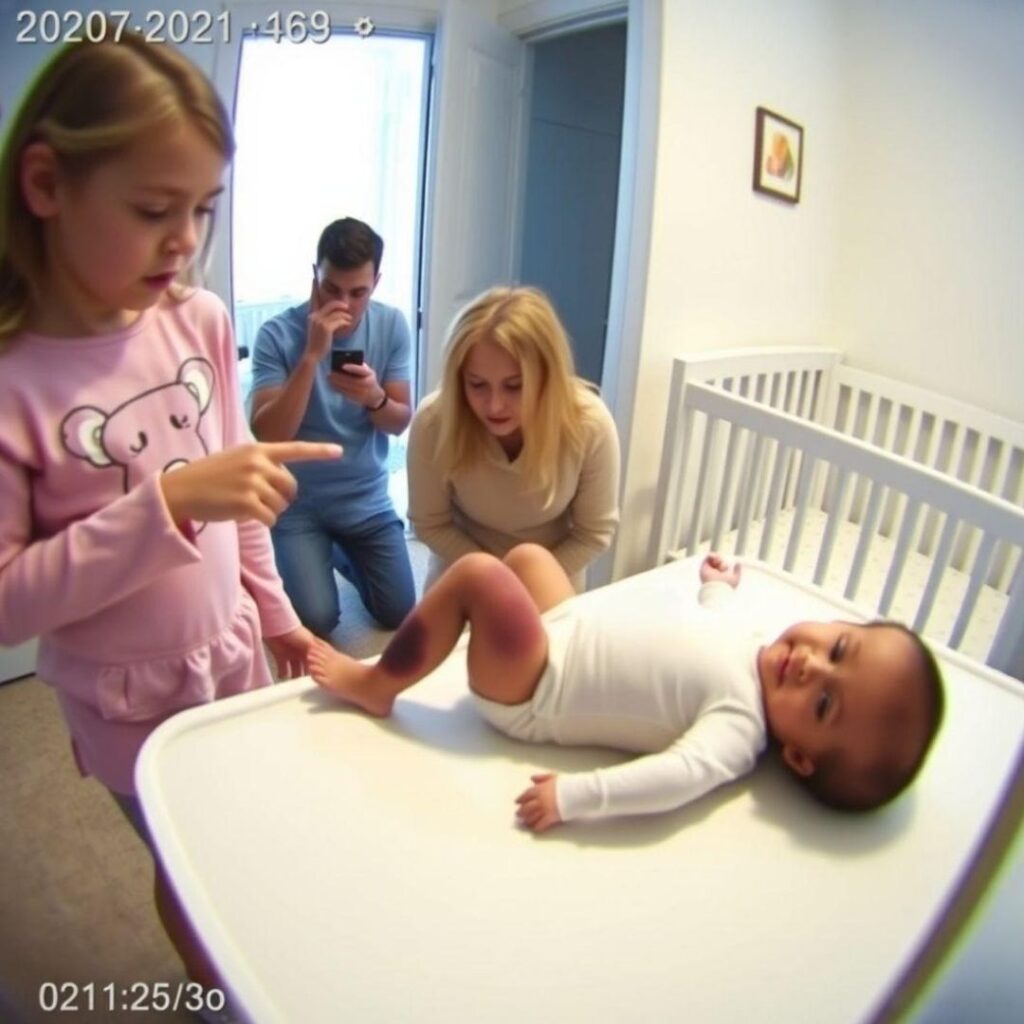
I watched as she left in silence, clutching her purse, barely glancing at us.
“I don’t like her face,” James muttered.
“What do you mean?”
“She didn’t cry. Didn’t ask how Emery was. Just… silent. Cold.”
He was right. Heather wasn’t acting like a panicked mother—more like someone calculating her next move.
At midnight, the hospital called. Emery was stable but admitted for observation. The bruises were confirmed: non-accidental trauma. Medical staff ruled out any underlying illness or blood disorder.
They were consistent with grip marks.
I sat in the kitchen, staring at nothing, while James paced behind me.
“They’ll ask about Heather’s boyfriend,” he finally said.
I blinked. “Boyfriend?”
“Heather mentioned him a few times. Travis, or Trevor… I don’t know. She said he didn’t like kids.”
I felt sick.
The next morning, CPS called us back in. Emery was staying in protective custody. Heather was being questioned. And yes, they had located the boyfriend—Travis Henson, 33, two prior assault charges, one involving a bar fight, another involving his own stepbrother.
He’d been living in Heather’s apartment for the last four months.
We hadn’t known.
Heather had never told us.
When the police tried to bring Travis in for questioning, he was gone. Disappeared from his job, no sign at his apartment. Heather claimed she hadn’t seen him in a week—but her phone records said otherwise. She’d texted him two hours before arriving at our house.
The suspicion turned toward her.
Had she known? Had she covered for him?
Or worse… had she been involved?
James sat across from the detective with his jaw tight. “We just want Emery safe.”
“That’s the goal,” the officer said. “Right now, Heather is being treated as a potential accomplice. She’s not in custody yet, but her access to the baby is restricted.”
I looked at James. “If Emery can’t go back to her… what happens?”
“You can request emergency custody,” the CPS worker said gently. “Since you found the injuries and acted immediately, you’re in good standing.”
The thought terrified me—but losing her was worse.
That evening, Heather showed up at our door. She looked thinner. Pale. Nervous.
“I didn’t do anything,” she said. “It was him. Travis. I didn’t know it was this bad.”
“You let him live with you,” James said, voice low. “Around your newborn.”
“I was tired,” she snapped. “Alone. He said he loved me.”
“You didn’t love Emery enough.”
The words left my mouth before I could stop them.
Heather turned red. Then she broke down crying.
But none of us trusted those tears.
The following weeks were filled with court dates, interviews, and more medical evaluations. Emery stayed in the pediatric care ward, gaining weight slowly, feeding well, and showing no signs of lasting injury.
CPS launched a full investigation into Heather’s home life. Photos were pulled from her apartment—unwashed bottles, a cracked crib, empty formula cans, stained baby clothes on the floor.
Heather tried to paint herself as overwhelmed. Postpartum. Isolated. She blamed Travis for everything.
But when pressed, she admitted she suspected he was rough with Emery.
And didn’t stop him.
That was enough.
She lost custody—temporarily, the court said. But with the weight of her decisions, the likelihood of permanent loss loomed.
We were granted emergency kinship custody. Emery came home with us two weeks later. Lila was ecstatic—carefully gentle, helping with bottles, patting her back during burps like a tiny pro.
We converted the guest room into a nursery. Bought new clothes. Safe formula. We took turns with night feedings. Exhausted, but grateful.
Heather called once. James picked up. She asked to visit.
“Not yet,” he said firmly. “You need to finish parenting classes. Prove you’re safe.”
She didn’t argue.
I didn’t hear from her for a month.
Then one morning, I got a letter. Handwritten. No return address.
I don’t expect you to forgive me.
I know I failed Emery. I thought I was doing my best. But I let love blind me.
I’m going to therapy. I’m in the classes. I’m going to try to fix what I broke.I hope one day you can tell her I loved her. Even if I didn’t deserve to raise her.
No signature. But I knew it was Heather.
I folded the letter and kept it. Not for her. For Emery.
One day, if she asks, I’ll tell her the truth—not all the details, but enough.
That she had a mother who made terrible choices.
And an aunt and uncle who chose her.
THE COST OF LOOKING AWAY
The first night Emery slept in our house, I didn’t.
I lay awake on the couch, listening to the soft rise and fall of her breathing through the baby monitor. Every tiny sound—every hiccup, every squeak—made my chest tighten. I kept seeing the bruises. Kept replaying the way Heather’s eyes had flickered, calculating instead of panicking.
James sat beside me, silent. At around 3 a.m., he reached for my hand.
“You did the right thing,” he whispered.
“I know,” I said.
But knowing didn’t make it easier.
The following weeks reshaped our lives completely.
CPS workers came and went, their clipboards always full. Pediatric specialists examined Emery carefully, documenting everything. They were kind, but precise—trained to see what the rest of the world preferred not to.
The bruises faded. That was the blessing and the curse.
As her skin cleared, so did Heather’s supporters.
Our mother called first.
“She’s still your sister,” she said, voice tight with defensiveness. “Postpartum depression is real. You don’t understand what she was going through.”
“She knew he was hurting Emery,” I said quietly. “She admitted it.”
There was a pause. Then, softer: “She didn’t think it was that bad.”
James took the phone from me.
“She didn’t think it was bad because she didn’t want to,” he said. “That’s not confusion. That’s negligence.”
The family divided itself cleanly after that.
Some said we’d overreacted. That calling 911 was extreme. That CPS ruined families and that Heather deserved grace.
Others said nothing at all—and that silence hurt the most.
Heather’s court-appointed attorney contacted us about supervised visitation.
“She wants to see her daughter,” the woman said, professionally neutral.
“She lost that right,” James replied.
But the court didn’t see it that way.
The first visit was held in a sterile room with pastel walls and plastic toys bolted to the floor. A social worker sat in the corner, notebook ready.
Heather walked in slowly.
She looked older. Thinner. Her hair was pulled back, her hands trembling.
When she saw Emery in my arms, something cracked.
“Oh,” she breathed. “She’s gotten bigger.”
She reached out instinctively—and stopped herself.
“Can I?” she asked.
I hesitated, then nodded.
Heather held her awkwardly, like someone afraid of breaking glass. Emery squirmed, then settled. She didn’t cry.
That hurt more than if she had.
Heather cried instead.
“I never meant for this,” she whispered. “I loved her. I still do.”
I wanted to scream.
Love doesn’t look away.
Love doesn’t choose comfort over safety.
Love doesn’t stay silent when a baby cries in pain.
But I said nothing.
Because Emery slept peacefully against her chest, and the social worker was watching everything.
After the visit, Heather collapsed into a chair.
“They say I can get her back,” she said, desperation sharp in her voice. “If I finish the classes. Therapy. If I stay clean. If I testify against Travis.”
“Will you?” James asked.
She nodded quickly. “Yes. Anything.”
The trial came faster than expected.
Travis was arrested three states away after a bar fight landed someone in the hospital. When police ran his name, the warrant flagged immediately.
He didn’t deny hurting Emery.
“She cried too much,” he said during questioning. “I was just trying to get her to shut up.”
Heather testified.
She told the truth—finally.
She said she saw the marks once and convinced herself they were from tight swaddling. That she heard Emery cry when she wasn’t in the room and told herself it was normal. That she knew, deep down, something was wrong—and stayed anyway.
The courtroom was silent when she finished.
The judge didn’t look at her with anger.
He looked at her with disappointment.
Travis was sentenced.
Heather was not—but the damage was already done.
Months passed.
Emery learned to smile. To laugh. To reach for Lila’s hair with sticky fingers. She grew strong and alert, eyes bright, voice loud.
Safe.
Heather completed every requirement. Every class. Every evaluation. She stayed sober. She attended therapy twice a week. She followed every rule.
Eventually, the court ruled in her favor.
Partial custody. Supervised at first. Then weekends.
The day they told us, I cried in the car.
Not because I didn’t believe in second chances—but because I believed in memory.
Because babies don’t remember pain.
But bodies do.
The transfer happened slowly.
Emery didn’t cry when Heather took her.
That hurt too.
On the last night before she left our home, I rocked her until she fell asleep. I pressed my lips to her forehead and whispered a promise she couldn’t understand.
“You were never invisible,” I said. “Not here.”
Heather hugged me at the door the next morning.
“I know you hate me,” she said.
“I don’t hate you,” I replied honestly. “I just don’t trust you.”
She nodded. “That’s fair.”
Life moved forward.
Quieter. Heavier. Changed.
Lila once asked me, “Mom… did we save Emery?”
I knelt beside her.
“We made sure someone listened,” I said. “Sometimes that’s how saving starts.”
Years later, Emery would be too young to remember the bruises.
But she would grow up knowing something else instead.
That when her cry finally reached someone who couldn’t ignore it—
They answered.
EPILOGUE — WHAT REMAINS
Emery was nine years old the first time she asked why she had lived with us.
Not in fear.
Not in tears.
Just curiosity—quiet, thoughtful, and steady.
We were sitting on the porch one summer evening, fireflies blinking in the yard like tiny signals. Lila, now a teenager, was stretched out on the steps with her headphones on, half-listening, half-dreaming.
“Why did I stay here when I was a baby?” Emery asked, swinging her legs.
I took a breath. This was the moment I had prepared for—but never rehearsed.
“Because you weren’t safe for a little while,” I said gently. “And when kids aren’t safe, grown-ups are supposed to protect them.”
She considered that. “Was it my fault?”
“No,” I said immediately. “Never. Not even a little.”
She nodded, accepting it the way children accept truth when it’s offered without fear.
“My mom’s better now,” she said.
“She worked very hard to be,” I replied. “And she still has help. That’s important.”
Emery leaned her head against my shoulder. “I like that lots of people took care of me.”
So did I.
Heather and I were not close—but we were respectful. Boundaries replaced bitterness. Supervised visits became normal visits. Normal visits became shared holidays. Trust didn’t return all at once—but responsibility did, and sometimes that mattered more.
Heather never blamed us again.
She never rushed Emery’s affection or tried to erase the past. When questions came, she answered them with honesty that hurt—but healed.
Lila grew up with a sharper sense of justice than most kids her age. She became the friend who noticed bruises. The one who spoke up when something felt wrong. The one teachers trusted.
Once, during a school project, she wrote:
“Adults don’t always protect children. But children can still be heard—if someone is willing to listen.”
James and I framed it.
People sometimes asked how we lived with the guilt—of not knowing sooner, of being related to someone who had failed so badly.
The truth is, guilt never disappears.
But it changes shape.
It becomes vigilance.
It becomes courage.
It becomes the refusal to look away.
Years later, Emery would grow into a confident, empathetic young woman who volunteered at a children’s center. She never knew why certain cries made her stomach twist—but she always responded.
And maybe that was the quiet miracle.
Not that pain disappeared.
But that it stopped echoing forward.
Because once—when it mattered most—
Someone saw the bruises.
Someone made the call.
Someone chose the child.
And that choice stayed.
