My name is Diane Caldwell. I am thirty years old, I reside in a quiet corner of Seattle, and on the night my younger sister was married, I learned two absolute truths about human nature.
First: Humiliation has a distinct auditory signature. It isn’t the collective gasp of a crowd, nor is it the raucous peel of laughter. It is the tiny, razor-sharp silence that detonates inside your own skull the moment you realize you have ceased to be a person and have instead become entertainment.
Second: The people who scream the loudest about class are usually the ones who possess the least of it.
The lesson began at the Fairmont Olympic, a venue that smelled of old money and aggressive floral arrangements. We sat under chandeliers that resembled frozen fireworks, exploding in suspended animation above a ballroom filled with guests who looked as though they had been curated from a catalog designed to make ordinary people feel inadequate.
Maria, my sister by two years, was the bride. She looked ethereal in silk and lace, though if you looked closely, her smile was pinned onto her face with sheer will, holding her fragile composure together. Beside her stood Gerald Whitaker—her new husband—grinning with the smug satisfaction of a man who had just acquired a trophy he didn’t quite understand but knew was valuable.
I had been the inconvenient shadow all day.
Gerald’s parents, Edward and Sophia Whitaker, had treated me like a regrettable charity case since our first introduction. They had assessed my beat-up Honda, my off-the-rack sensible shoes, and my modest demeanor, and decided I was a broke graphic designer. They had also decided, without ever asking, that a lack of funds equated to a lack of worth.
I had allowed this assumption to stand.
Not because I enjoyed the condescension, but because I wanted to see. I had spent years keeping my financial reality quiet for a simple reason: money is a high-powered flashlight that alters how people behave. When they believe you can buy them, they smile with their eyes. When they believe you are of no use to them, they show you their teeth.
The wedding day unfolded like a meticulously rehearsed performance. I watched the valet park my Honda between a Tesla and a gleaming BMW, his nose wrinkling slightly. Inside, Sophia Whitaker descended upon me like a queen greeting a scullery maid.
“Diane,” she announced, her voice pitched just loud enough to draw attention. “You made it. Everyone, this is Maria’s sister. She does… graphic design, isn’t it?”
Heads turned. Eyes scanned my navy dress and the small, wrapped gift in my hands. Their smiles were thin, the kind used to dismiss someone swiftly.
I smiled politely and accepted a glass of water instead of champagne. I am a Type 1 diabetic, and I knew the day would test both my blood sugar and my patience.
They seated me in row eight. My parents, Walter and Catherine, were in row three, but even they were separated from the “VIPs.” Gerald’s family and business associates occupied the front rows like they were attending a coronation.
During the reception, Gerald drifted over, tie loosened, eyes glassy with champagne and a sharpening cruelty.
“You’re missing out,” he slurred, gesturing to the dessert display—a five-tier architectural marvel surrounded by gold-dusted pastries.
“I’m good with water,” I said.
He laughed, a booming sound that acted as a magnet for the room’s attention. “Water. Come on, Diane. Live a little. Or is that not in your budget?”
A few guests chuckled. Maria’s eyes flicked toward us, panic flaring, before she looked away.
Then came the cake cutting. The guests swarmed with phones raised. I hung back, finding a waiter who had kindly sourced a small plate of fruit for me. I felt a momentary wave of relief, a safe harbor in the storm of excess.
Until Gerald’s voice boomed directly behind my ear.
“Fruit? Seriously, Diane?”
He was closer now, the smell of alcohol pungent. “You’re at a wedding with a fifty-thousand-dollar cake and you’re eating apples like some broke intern?”
The air in the ballroom shifted. The circle around us tightened.
“I’m diabetic,” I said, keeping my voice even. “I have to be careful.”
Gerald laughed, stepping into my personal space. “Diabetic? Sure. Or maybe you just can’t afford the good stuff.”
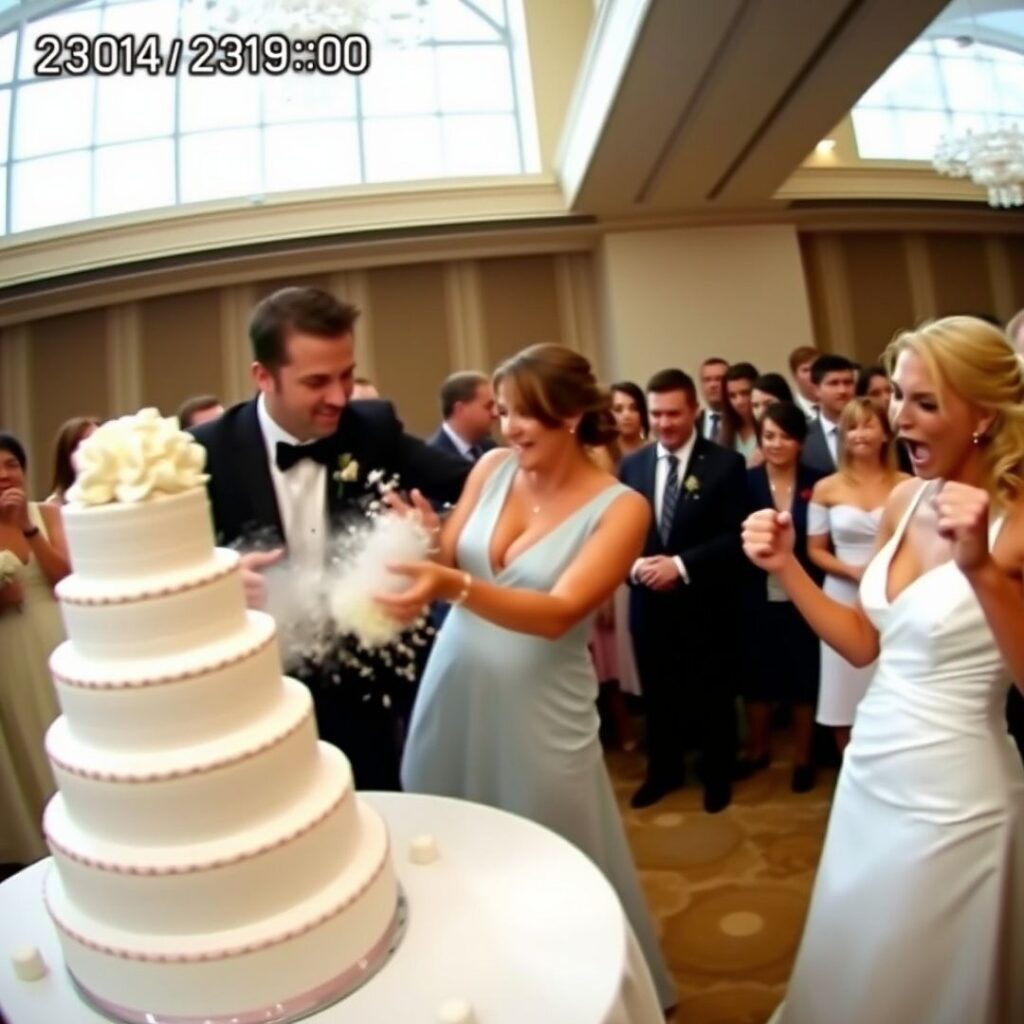
Before my brain could process the shift in his body language, his hand shot out. He grabbed my shoulder, hard, and shoved me forward.
My face slammed into the cake.
The impact was soft but suffocating. Buttercream flooded my nose and mouth. The cold, cloying shock of sugar and vanilla pressed into my eyes. I felt the sickening squish of an expensive confection turning into a weapon.
The ballroom erupted—gasps, laughter, the click of camera shutters.
I pulled back, gasping for air, icing dripping down my chin. My dress was ruined. My heart hammered against my ribs, and I could already feel the adrenaline spiking my blood sugar. My hands trembled—not from weakness, but from the searing heat of absolute humiliation.
Gerald stood there grinning, wiping a speck of frosting from his lapel.
“Enjoy the frosting, cheapskate!” he shouted.
Maria’s voice cut through the noise, high and horrified. “Gerald—what the hell?”
And in that frozen moment, as I wiped sugar from my eyelashes, I realized this wasn’t just about me. This was the moment the curtain fell.
For a second after my face hit the cake, my body attempted to go numb. It was a survival instinct, a way to distance the mind from a reality too grotesque to process. My ears rang. The room was a blur of movement through the frosting smeared across my vision. I blinked hard, tasting bile and sugar.
People were recording. Of course they were. In a room filled with status addicts, my humiliation wasn’t a tragedy; it was content.
Maria pushed through the crowd, her wedding dress a bright white spill in the chaos. She looked as though she had been slapped—forced to witness a brutality she couldn’t rationalize away.
“Gerald, what is wrong with you?” she demanded, her voice trembling.
Gerald lifted both hands in exaggerated innocence. “Babe, relax. It’s a joke.”
A joke. My health risk turned into a spectacle. Months of subtle insults sharpened into one loud, sticky moment.
“You humiliated her,” Maria said, the shock beginning to curdle into rage.
Gerald scoffed, his grin still plastered in place. “She’s fine. She’s always so uptight. I thought she could use some fun.”
That was when Maria’s hand moved.
The slap landed across Gerald’s cheek with a sound so clean, so sharp, it felt like the foundation of the hotel cracked.
The silence that followed was heavy, physical.
Gerald stumbled a half-step back, the grin wiped clean. His eyes darted to his parents, Edward and Sophia, as if waiting for them to enforce the rules of his world—the rules where he was untouchable.
Sophia’s mouth opened and closed like a fish on a dock. Edward’s face went stiff, his eyes calculating the PR damage in real-time.
“How dare you touch my sister?” Maria said, her chest heaving. “How dare you.”
“Maria, come on—” Gerald started, his cheek reddening.
“No,” she snapped. “You’ve been letting your parents treat her like dirt for months. You’ve been smirking every time they do it. And now you put your hands on her?”
Gerald spread his hands again, pivoting to the crowd to plead his case. “I was drunk. I didn’t think—”
“No, you did,” I said quietly.
The room turned to me. I was still dripping icing, my hair matted to my temples. I should have looked pitiful. Instead, a strange, cold calm settled over me—the calm of a person who has decided to burn the bridge while standing on it.
“You did think,” I repeated, wiping my mouth with a napkin a waiter had numbly handed me. “You thought I was beneath you. That’s why you did it.”
Edward stepped forward, donning his practiced business mask. “Diane, let’s not make a scene. Weddings are emotional—”
I laughed, a short, humorless sound. “You mean like shoving my face into a cake?”
Then, a man stood up from a table near the back.
He was in his mid-sixties, silver-haired, wearing a suit that whispered wealth rather than shouting it. He moved with the steady confidence of a man who owned the room he walked into.
“Hold on,” he said, his voice carrying effortlessly. “Let me clear something up.”
Heads swiveled. I recognized him instantly. Charles Avery.
I hadn’t expected him here. We had crossed paths years earlier in investment circles, back when I was turning my initial windfall into an empire. He was one of the few who had treated me with respect before he knew the size of my portfolio.
Charles pointed toward me, not with pity, but with absolute deference.
“This is Diane Caldwell,” he announced. “One of the sharpest early-stage investors in the Pacific Northwest.”
The atmosphere shifted. Phones came out again, thumbs flying across screens, verifying the name.
Charles continued, his voice hardening. “She backed Innovate Solutions when it was nothing more than a PDF deck. She turned five thousand dollars into millions. Her net worth is comfortably over a billion.”
A gasp rippled through the ballroom like a sudden gust of wind.
Gerald’s face drained of color so fast it was almost clinical. The smugness collapsed into panic. Edward’s smile froze, a rictus of terror. Sophia’s eyes went wide, darting around the room as if searching for an escape hatch.
Someone whispered, “Forbes.”
Charles didn’t stop. “She lives modestly by choice. She works because she enjoys it. And she doesn’t flaunt her money because she prefers to see who people truly are when they think she is nobody.”
He looked directly at Edward and Sophia.
“Well,” Charles said, his voice cutting like a scalpel. “I think we have all seen exactly who you are.”
The strangest part of being revealed as a billionaire in a room full of social climbers wasn’t the shock; it was the immediate, mathematical recalculation occurring in two hundred brains simultaneously.
It happened on their faces like a light switch flipping. People who had laughed minutes ago now looked horrified. Guests who hadn’t deigned to make eye contact were suddenly staring at me as if I radiated a holy light.
Gerald stood frozen, blinking rapidly. Edward stepped forward, his voice suddenly thick with warmth.
“Diane,” he said, reaching out a hand. “This is… clearly a misunderstanding.”
I stared at him, the frosting beginning to crust on my skin. “Which part?” I asked. “The part where your son assaulted me? Or the part where you’ve been mocking my poverty for six months?”
Sophia fluttered forward, her smile trembling like a cheap curtain over a broken window. “Honey, we had no idea,” she said breathlessly. “Maria never told us—”
“Exactly,” I said.
Maria turned toward her new in-laws, betrayal twisting her features. “You’re saying you treated her like garbage because you thought she was poor? And that makes it okay?”
Sophia spread her hands. “We were just teasing! It’s harmless family humor.”
Charles Avery let out a short, dark laugh from the crowd. “Harmless? You just watched your son assault a diabetic woman and called it humor.”
Gerald finally found his voice, thin and desperate. “Diane, I didn’t know. If I’d known—”
I finished the sentence for him. “You would have treated me like a person.”
Gerald flinched.
Maria looked at her husband, and I saw the last thread of her denial snap. “So, dignity has a price tag for you?” she asked him.
“Babe, please,” Gerald begged, sweating now. “It was a joke. I didn’t mean—”
“You did,” Maria said, her voice raw. “You meant it because you enjoyed it.”
The crowd was no longer just watching; they were choosing sides. And in a room like this, people always choose the side with the bigger bank account.
Edward tried to salvage the sinking ship. “Maria, think about the guests. The reputation. We can discuss this privately.”
Maria’s laugh was small and bitter. “My reputation? You mean your reputation.”
She turned to face the ballroom, the hundreds of strangers witnessing her fairy tale turn into a horror show.
“I’m leaving,” she said, her voice loud enough to carry to the back row.
Gerald lunged toward her, panic overriding his sense. For a split second, I thought he might grab her arm the way he had grabbed mine. But Maria’s glare stopped him cold.
“Move,” she commanded. There was steel in her voice I hadn’t heard in years.
I felt my own body sway. The adrenaline crash was coming, and my blood sugar was likely climbing into dangerous territory. I needed insulin. I needed air.
But Maria needed something more urgent: an exit.
I stepped beside her. Edward hissed under his breath, “Diane, this is unnecessary. Think of the partnerships we could build. The synergy.”
Even now, standing in the wreckage of his son’s marriage, the man was calculating profit.
I looked him in the eye. “I’m thinking about what Maria loses if she stays.”
We walked toward the exit. The crowd parted like the Red Sea. I could feel eyes burning into my back, capturing every detail of the ruined dress and the billionaire underneath it.
Outside, the cool Seattle air hit my face, a blessed relief. Maria ran after me into the valet area, hiking up her twenty-thousand-dollar dress, mascara streaking down her cheeks.
“Diane, wait!” she cried.
I turned. Maria stopped, breathing hard, looking like a runaway queen.
“I’m sorry,” she sobbed. “You were right. About all of it.”
My throat tightened. “I’m sorry too. I should have told you sooner.”
Maria’s lips trembled. “Take me home.”
And just like that, my sister climbed into my beat-up Honda, and we drove away from the wreckage of her wedding.
Driving through downtown Seattle in a Honda Civic while your sister weeps in the passenger seat wearing a couture wedding gown is a surreal experience.
Maria’s dress filled the small car like a deflated cloud. The tulle rustled every time she shifted. She stared out the window as the city lights blurred by.
“I can’t believe I married him,” she whispered.
I gripped the steering wheel, my knuckles white. “You don’t have to stay married,” I said.
Maria twisted the diamond ring on her finger. “Annulment,” she said, testing the word. “Divorce. God, I feel so stupid.”
“You’re not stupid,” I said fiercely. “You were sold a fake bill of goods.”
We stopped at a red light. I pulled my glucose monitor from my purse, pricked my finger, and watched the number climb. High, but manageable.
Maria noticed. “Are you okay?”
“I will be,” I said, injecting a measured dose of insulin. “Just stress. And cake.”
Maria winced. “I’m so sorry.”
“Don’t,” I said. “This isn’t on you.”
By the time we reached my apartment in Capitol Hill, the building looked comically plain compared to the Fairmont. No doorman, just a buzzing intercom and a worn elevator.
Maria stepped inside and sank onto my thrift-store couch. “This place feels like home,” she said softly.
I made coffee—strong and black for her, tea for me. We sat at my small kitchen table as the clock ticked past midnight.
“Tell me the truth,” Maria said finally. “About the money.”
So I did. I told her about the lean years after college. I told her about the two guys in a coffee shop with a frantic need for five thousand dollars to save their code. I told her how I invested because I believed in them, not the product. Two years later, their company sold for forty million. My equity stake ballooned. And then, instead of buying yachts, I learned. I reinvested. I built quietly.
“And you kept living like this,” Maria said, gesturing to my IKEA shelves.
“Because this is enough,” I said. “And because safety isn’t about things. It’s about freedom.”
Maria shook her head. “Gerald’s family would lose their minds if they heard you say that.”
“That,” I said, “is precisely the point.”
We talked until 2:00 AM, dismantling the lies Gerald had fed her. He had isolated her, critiqued her, molded her into an accessory.
“I ignored the signs,” she admitted, her voice thick with shame. “Because I wanted the dream.”
I reached across the table and took her hand. “Sometimes people sell you a dream so you won’t notice the cage.”
One night, surrounded by boxes in my living room, Maria looked at me.
“Promise me something,” she said.
“Anything.”
“No more secrets,” she said. “Not between us.”
“Deal.”
It is fascinating how quickly humans evolve into insects when they smell sugar.
The week after the wedding, my inbox became a hive of activity. Messages poured in from people who hadn’t spoken to me in a decade.
Hey Diane, crazy night! Let’s grab coffee!
Always admired your vision, Diane. Let’s connect.
It was nauseating.
Gerald and his parents tried a different tactic. Edward sent a formal email, written as if to a business rival, suggesting a meeting to “restore harmony and discuss potential synergies.”
I replied with one sentence: Do not contact me again. Direct all communication to Maria’s attorney.
Within hours, Sophia called my mother, weeping, claiming I had ruined Maria’s life with my “deception.” My mother, bless her, hung up on her.
Maria moved in with me while Lauren, an old friend and ruthless family law attorney, filed for annulment. The video of the assault made it easier; Gerald’s family didn’t want a discovery process that would air more dirty laundry.
But stress has a way of finding cracks.
Three days later, I woke up with my heart hammering like a trapped bird. My vision blurred. I ended up in urgent care, hooked up to IVs, my blood sugar having gone rogue.
Maria sat by the bed, terrifyingly pale. “This is my fault,” she whispered.
“No,” I rasped. “This is Gerald’s fault.”
When we returned to my apartment, Gerald was waiting.
He stood by my Honda, looking like a man whose world had been stolen. His suit was rumpled, his face unshaven.
Maria froze. Then, she squared her shoulders. “I’ve got this.”
We walked up to him. Gerald’s eyes lit up with desperate hope. “Maria—thank God. Please, just talk to me.”
“Why are you here?” Maria asked, her voice ice.
“I messed up,” he pleaded. “My parents are driving me crazy. They’re blaming me, they’re blaming you—I just need you back.”
“You don’t need me,” Maria said. “You need a prop.”
Gerald turned to me. “Diane, please. I’m sorry about the cake. It was a joke.”
“I don’t care what you meant,” I said, leaning against the building for support. “I care what you did.”
Gerald sneered, his mask slipping. He gestured at my car, at the modest brick building. “You’re really going to throw away everything we had to live like… this?”
Maria stared at him. “This is real,” she said. “And you never were.”
Gerald stepped closer, his face hardening. “You’ll regret this.”
“I already regret marrying you,” Maria said. “Leaving you is the first thing I’ve done right in months.”
She turned her back on him and walked into the building. The heavy door clicked shut, sealing him out.
The Whitakers did not go quietly.
Edward and Sophia had built their lives on the bedrock of reputation, and reputation is a fragile thing. They couldn’t erase the video of the cake incident, so they tried to rewrite the narrative.
Rumors began to float through Seattle. Gerald was “under stress.” Maria was “unstable.” Diane was a “manipulator” using her wealth to control her sister.
Maria read the posts online, her face tight. “They’re trying to make you the villain.”
“Let them,” I said. “Villains are just characters with boundaries.”
But Charles Avery had other ideas.
He called me one rainy Tuesday. “Diane. Edward’s company is quietly looking for investors. Image-conscious ones.”
I swiveled in my chair. “And?”
“And image is currency,” Charles said. “If I were to mention—casually—that the Whitakers have a habit of assaulting women at public events, that currency might devalue.”
I hesitated. “That sounds like revenge.”
“It’s accountability,” Charles corrected.
“Do what you think is right,” I said.
Two weeks later, Edward Whitaker lost a major strategic partnership. Publicly, it was a “realignment.” Privately, it was because nobody wanted to bankroll a family that had become a viral symbol of entitlement.
Sophia sent Maria a handwritten letter next. It was a masterpiece of gaslighting, claiming she loved Maria like a daughter and that I was poisoning her mind.
Maria read it once, then tore it in half.
“I’m done with their theater,” she said.
One evening, we sat on my balcony, eating pizza.
“Do you regret hiding the money?” Maria asked suddenly.
I looked at the skyline. “Sometimes. But if I hadn’t, I wouldn’t have known who they really were until it was too late.”
Maria leaned her head on my shoulder. “It didn’t cost me,” she whispered. “It saved me.”
The internet loves a villain, but it loves a redemption arc even more. Maria, however, wanted neither. She wanted her name back.
But the Whitakers weren’t done.
A week later, Maria came home from her new job at a bookstore, shaking. “HR called me in.”
“What?”
“Someone sent an anonymous email. Claiming I’m emotionally unstable and a liability because of the ‘wedding incident.’”
My blood ran cold. This was the pettiness of the powerless wealthy.
“Do you want me to destroy them?” I asked, and for the first time, I meant it. I had the resources to bury them in legal fees for a decade.
Maria took a deep breath. “No. I want to handle it.”
She went back to HR the next day. She didn’t cry. She presented the annulment papers, the police report regarding the assault (which we had filed but not pursued), and a calm, factual statement.
HR backed her. The email sender was blocked.
“That,” Maria said that night, pouring wine, “felt like getting my spine back.”
When the annulment was finalized, we didn’t celebrate with champagne. We went to a park with our parents and ate sandwiches.
Maria took off her ring and dropped it into a box labeled PAST.
“Your turn,” she said to me.
“For what?”
“To stop hiding,” she said gently. “You’ve been so afraid of being used that you’ve built a wall that keeps the good people out too.”
I stared at her. She was right.
“Okay,” I said. “No more walls.”
A year later, Charles invited us to a charity gala.
“The Whitakers will be there,” he warned. “They’re trying to buy their way back into society.”
“I’ll go,” I said.
Maria insisted on coming. “I’m not hiding.”
The event was sleek, filled with the kind of people who speak in hushed tones about equity. Edward and Sophia spotted us immediately.
They approached with forced smiles, cornering us near the bar.
“Diane,” Edward said, smoothing his tie. “Maria. Good to see you.”
“Is it?” Maria asked.
“We’ve all moved on, haven’t we?” Sophia chirped, her eyes brittle.
“Have you?” I asked.
Edward’s jaw tightened. “Diane, look. We regret the… optics of that night. But Gerald is struggling. His reputation is damaged. Surely you think he’s suffered enough.”
I laughed, and this time, it was genuine. “He’s suffering because people finally see him. That’s not punishment, Edward. That’s accuracy.”
“You think you’re better than us,” Edward hissed, his mask slipping.
“No,” Maria interrupted. “We just finally stopped believing you were better than everyone else.”
We walked away, leaving them standing there, small and angry in their expensive clothes.
Later, Charles found us. “That was elegant.”
“I’m done letting them control the story,” Maria said.
“And you?” Charles asked me.
“I’m done hiding,” I said. “I’m going to use my name.”
Two years after the wedding, Maria met me for coffee. She slid an envelope across the table.
“A book contract?” I gasped.
She nodded. “I wrote an essay about leaving. About boundaries. A publisher saw it.”
“Maria, this is amazing.”
“I didn’t write it for fame,” she said. “I wrote it because… I needed to read it.”
We watched the rain fall on the Seattle pavement.
“Do you think about the cake?” she asked.
“Yes,” I admitted. “It used to make me feel sick. Now… I see it as the moment the fog lifted.”
“If anyone ever calls you a cheapskate again—” Maria started, grinning.
“I am not doing cake-based character development twice,” I warned.
She laughed, loud and free.
The ending wasn’t about revenge. It was about construction.
I launched a fund. The Caldwell Initiative. It wasn’t for tech bros or established firms. It was for the underdogs—the diabetic designers, the kids with beat-up Hondas and brilliant ideas, the people who treat waiters with respect.
I stopped hiding my name. I stopped hiding my heart.
On the night of Maria’s book launch, our parents sat in the front row, beaming. Maria stood at the podium, holding her book like it was a shield she no longer needed.
She read the dedication: For Diane. The sister who saved me by refusing to be silent.
Afterward, we stood on the balcony of my new apartment—still not a mansion, but a place with a view I loved.
“Do you think they’re still mad?” Maria asked, referencing the Whitakers.
“Probably,” I said.
“Good.”
We stood there, two sisters who had survived the chandeliers and the cruelty.
Gerald had tried to make me small. Instead, he had forced me to become exactly who I was supposed to be.
I took a sip of tea. The city lights twinkled below, not like frozen fireworks, but like a thousand tiny truths, burning bright in the dark.
“So,” Maria said, bumping my shoulder. “What’s next?”
I smiled. “Everything.”
