I didn’t sleep that night.
He didn’t touch me—not in the way I feared. Instead, Charles poured us both a drink, gestured for me to sit, and spoke like we were old friends trapped in a waiting room.
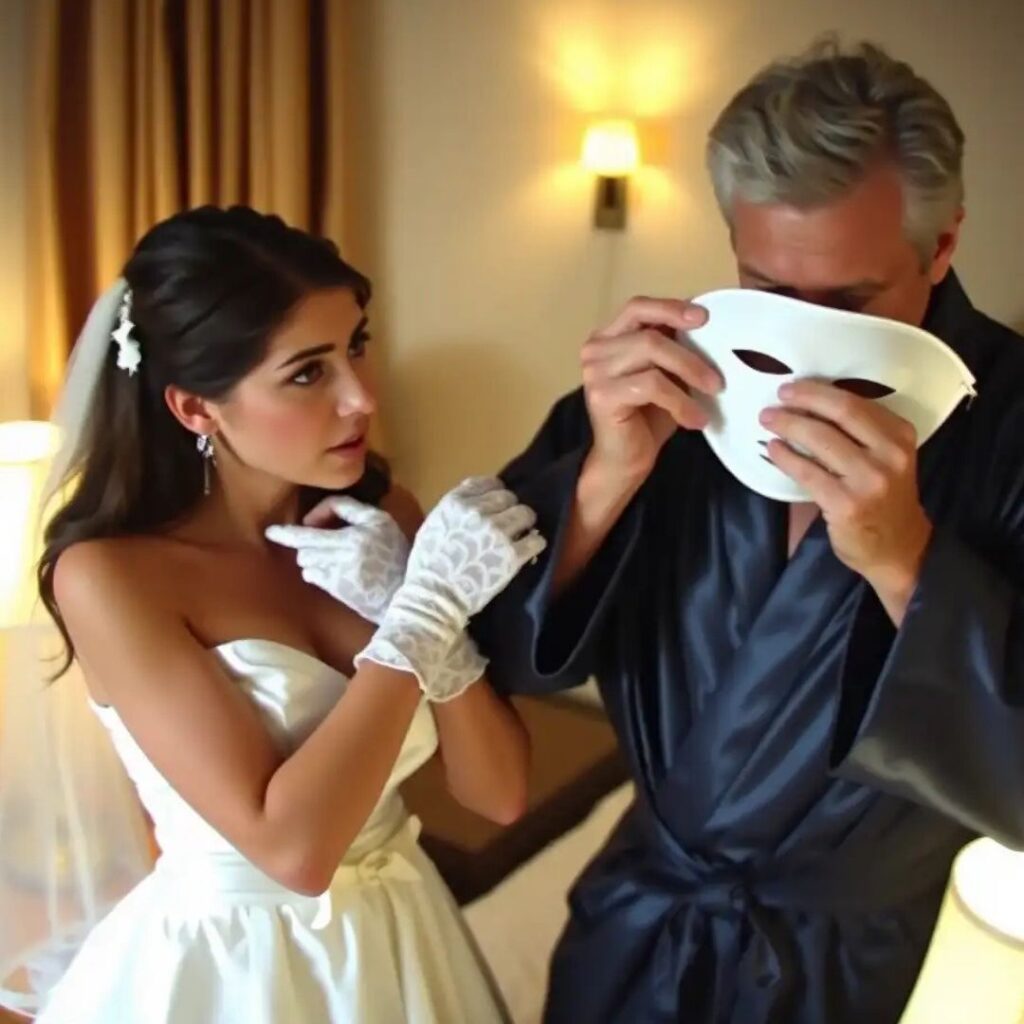
“I wasn’t born Charles Harwood,” he began. “My name was Gregory Humes. I was a cosmetic surgeon in Los Angeles for nearly thirty years. A damn good one, too.”
I sat stiffly in the chair across from him. I could still barely look at his face—how it shifted, how it clung too tightly in the wrong places. The glow of the lamp caught the sheen of synthetic skin, glued with clinical precision.
“I made a fortune off desperation. Actresses, executives, wives of senators—they came to me to become someone else. And they paid well.”
He took a sip of his bourbon. “But I got greedy. Too greedy.”
Turns out, Charles—or Gregory—had developed an illegal side business. Using experimental surgeries, facial reconstruction, and synthetic grafting, he helped criminals disappear by literally giving them new faces. He called it “erasure work.”
The FBI caught wind of it six years ago. His license was revoked. He faced thirty years in federal prison. But instead of serving time, he cut a deal. He testified against high-profile clients—names that could bury governments—and in return, they gave him a new identity: Charles Harwood. New name, new location, and a trust fund deep enough to keep him quiet and hidden.
“But the irony,” he said, laughing bitterly, “is that I had to become my own patient. The government paid another surgeon to rebuild my face so I’d disappear forever. They used one of my own designs. That’s why it doesn’t move right. It’s not mine.”
I asked him why he needed a wife.
He was quiet for a long time. Then he finally said, “Because the money has conditions. The trust activates in full only if I’m legally married by age sixty-three. It’s a clause meant for someone else, but I inherited it.”
I asked him why he chose me.
He looked me dead in the eyes. “Because you were desperate—and honest about it. No pretense. No lies.”
I stood up and left the room. He didn’t follow.
The next morning, I found him in the garden, pruning roses with latex gloves. He acted like nothing had happened.
That became our pattern. We lived like ghosts in that house. No intimacy. No arguments. Just silence and expensive wine.
But five weeks in, everything changed—when I received a letter from a woman named Iris Caldwell. The return address was from Nevada.
The letter said:
“You don’t know me, but I was married to Charles Harwood ten years ago. If you’re reading this, you’re in danger. He’s not what he says. He lied to me, too. And I barely escaped alive.”
Iris’s letter shattered the fragile acceptance I’d begun to build.
It was handwritten, each line tightly scrawled, like someone had forced the words onto the page. She wrote about her wedding to Charles—same mask, same secrecy, same estate—but ten years earlier, under a different name: Michael Desmond.
He’d told her the same story. Former surgeon. Government deal. Hidden life.
“He uses different aliases,” the letter read. “And every marriage is a transaction. Mine ended after six months, when I tried to leave.”
Iris claimed she discovered records hidden in a safe—documents proving that Charles had never testified. Instead, he’d staged his own disappearance after being connected to at least three missing women, all patients of his so-called erasure clinic.
The FBI file was sealed. But she’d copied parts of it before she ran.
“He’s not under witness protection,” she wrote. “He’s hiding. And every woman he marries disappears.”
I confronted Charles that night.
He didn’t flinch when I showed him the letter.
“I wondered when you’d hear from her,” he said, calmly placing a bookmark in his novel. “Iris is alive, yes. She ran. Took a hundred thousand dollars and disappeared. Smart woman.”
I asked him if what she wrote was true.
He sighed and looked tired again. “Some of it.”
He admitted to the aliases, the staged identity. But the women?
“They weren’t victims,” he said coldly. “They were partners. We had arrangements. And some couldn’t keep their side of the deal.”
I asked what happened to them.
He didn’t answer.
That night, I searched his study. I found a floorboard that gave way under pressure. Beneath it: a lockbox. Inside were IDs—driver’s licenses, passports, credit cards—all from women. Five names. Five faces.
And a scalpel.
The next morning, I packed a bag and tried to leave. The estate gates were locked. The driver was gone. My phone had no signal.
Charles met me in the foyer.
“You broke the contract,” he said simply.
He didn’t shout. He didn’t strike. He just looked… disappointed.
But I had planned for this. I’d sent photos of the IDs to a friend in Charleston, scheduled to forward them to the police if I didn’t check in within 48 hours.
Charles stared at me when I told him.
Then, unexpectedly, he smiled. “That was clever, Leah.”
I left the estate that afternoon. A car was waiting.
Two weeks later, federal agents raided the property. Charles Harwood—or Gregory, or Michael, or whatever his real name was—was gone. The estate had been emptied the night I left.
They never found him.
But sometimes, I still get letters. No return address. Just a white envelope, and inside, a pressed rose. Always with the same note:
“Well played.”
The FBI raid was a spectacle that lasted three days. They tore up the floorboards, drained the ornamental pond, and confiscated the ivory mask I’d left on the nightstand. But for all their thermal imaging and forensics, they found nothing but the empty shell of a life. Charles—if that was ever his name—had vanished like smoke through a keyhole.
Part 2: The Porcelain Debt
The money he promised my family didn’t disappear with him. It arrived in staggered, untraceable installments from offshore accounts in the Cayman Islands. My father’s medical bills were paid in full; my brother’s tuition was a non-issue. By all accounts, I had won. But “winning” with a man like Charles feels like holding a gift-wrapped bomb.
I moved to a small apartment in Seattle, as far from the humidity of Charleston as I could get. I changed my name, though not through a surgical erasure—just a legal one. I thought I was free until the first rose arrived.
Six months after the escape, I tracked down the real Iris Caldwell. It took three private investigators and a small fortune. I found her in a gated community in Arizona, living under the name Sarah Jenkins.
When she saw me, she didn’t look afraid. She looked exhausted.
“You’re the one from Charleston,” she said, ushering me into a house that was a mirror image of the Georgia estate—cold, minimalist, and expensive. “He told me you were the smartest one yet.”
“You wrote me that letter,” I said, my voice trembling. “You warned me he was a killer.”
Iris sat down and poured a glass of wine with hands that were as smooth and poreless as Charles’s. I gasped. She saw me looking and held her hand up to the light. It looked like high-end prosthetic work, fused to her skin.
“He didn’t kill those women, Leah,” she said quietly. “He harvested them.”
Iris told me the truth that the FBI had missed because they were looking for bodies. Charles wasn’t just hiding criminals; he was obsessed with the perfection of the human form. He didn’t just give people new faces; he took pieces of the women he married to refine himself.
“The synthetic skin he showed you? That wasn’t just plastic,” Iris whispered. “It was a collagen lattice grown from the biological samples of his ‘partners.’ He marries women with specific genetic markers—youth, resilience, rare blood types. He isn’t a surgeon anymore. He’s a gardener, and we are the soil.”
My stomach turned. I remembered the “blood tests” his staff insisted on before the wedding. I remembered the vitamins he made me take.
“He didn’t let you go because you were clever, Leah,” Iris continued. “He let you go because the procedure was already done. Check your hairline. Behind the left ear.”
I ran to her bathroom and pulled my hair back. There, so faint it looked like a natural crease in the skin, was a microscopic scar. It was perfectly circular, no larger than a grain of rice.
“It’s a tracker and a transmitter,” Iris said. “He’s been listening to us this whole time. He let you run because a bird in a cage provides no data. A bird in the wild, however… that tells him how his ‘product’ reacts to stress.”
I realized then why he had smiled. I wasn’t the victor. I was the prototype.
I stopped running. If he was listening, I would give him something worth hearing.
I spent the next three months working with a rogue bio-hacker I met through Iris’s connections. We didn’t try to remove the chip; we “overloaded” it. We fed the transmitter a looped signal of a flatlining heart and high-stress neurological white noise.
Then, I went back to Charleston. Not to the estate, but to the clinic where he was rumored to have started his “erasure” work.
I stood in the middle of the abandoned operating theater and spoke to the empty air.
“I know what I am, Gregory,” I said, using his first name. “I’m not your soil. I’m the infection you didn’t account for. I’ve shared the bypass code for your offshore accounts with the IRS. In ten minutes, your ‘trust’ won’t just be empty—it’ll be a beacon for every federal agency in the world.”
The silence was heavy. Then, the intercom on the wall crackled—a sound that shouldn’t have been possible in a building with no power.
“You always were my favorite, Leah,” his voice came through, smooth and synthetic. “But a gardener knows when to burn the crop.”
Epilogue: The Mask Falls
The building didn’t explode. Instead, a file was sent to my phone. It was a video.
It showed Charles—or the man who wore his face—sitting in a room that looked like a cockpit. He was peeling off the mask, but beneath it wasn’t another face. It was a mirror. A polished, silver surface that reflected nothing but the camera.
“There is no Charles Harwood,” the voice said. “There is only the design. And you, Leah, are the new architect.”
The video ended. My bank account pinged. Every cent he had stolen was now in my name—billions of dollars, enough to buy a thousand lives. Along with it came a list of names. The other women. The ones who hadn’t “escaped.”
He hadn’t just given me money. He had given me his throne.
I looked at the scalpel I’d taken from his lockbox. I realized that to truly win, I didn’t need to catch him. I needed to finish the work he started—but this time, I would be the one holding the blade.
I walked out of the clinic and into the light. I didn’t feel like a victim anymore. I felt like a warning.
