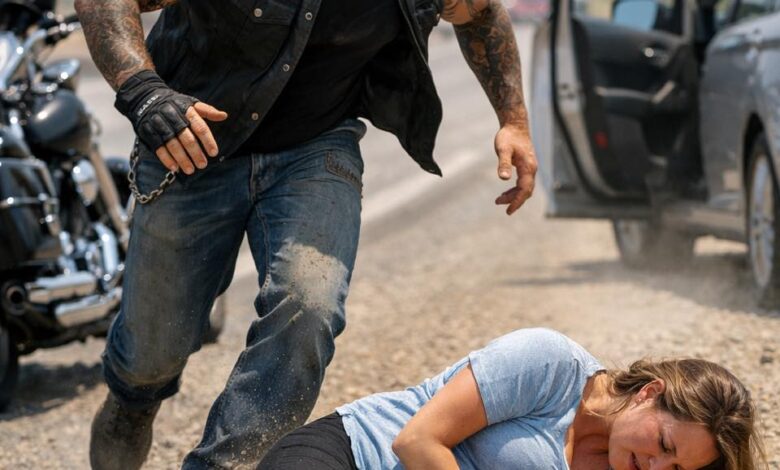
It sounds like the kind of headline people skim and assume is exaggerated: biker saves pregnant woman on the side of the highway. Too cinematic. Too neat. But on a blistering afternoon along Highway 17 in southern Missouri, it unfolded in a way that was messy, frightening, and painfully real.
For nearly thirty minutes, drivers had been passing the same sight on the shoulder: a broad-shouldered man sitting astride an aging charcoal Harley-Davidson, engine idling in a low, uneven growl. Heat shimmered off the pavement, turning the horizon into a wavering blur. The biker’s name was Dylan Cross, though no one speeding past at seventy miles an hour knew that. They saw the tattoos on his forearms, the weathered leather vest stitched with faded patches, the heavy boots planted firmly on cracked asphalt.
Inside sealed, air-conditioned vehicles, people made silent decisions. Don’t slow down. Don’t stare. Definitely don’t stop.
Dylan noticed the double takes, the quick glances followed by deliberate avoidance. He had grown used to it. He had pulled over because his engine temperature had spiked climbing the previous hill. Years earlier, he might have ignored the warning light. Not anymore. He sat listening to the ticking of hot metal cooling beneath the punishing sun, sweat tracing a line down his spine.
Then he saw the sedan.
A pale green car drifted unevenly toward the shoulder a few hundred yards ahead. At first he assumed the driver was distracted. But the motion was wrong—unsteady, urgent. The vehicle rolled to a stop at an awkward angle, half on gravel, half on pavement.
The driver’s door opened slowly. A woman stepped out, one hand gripping the frame for support, the other clutching her stomach. Even from a distance, the swell of late pregnancy was unmistakable beneath her summer dress.
She took two shaky steps away from the car.
Then her knees buckled.
Traffic continued flowing.
A pickup swerved slightly. An SUV slowed just long enough for the driver to stare. No one pulled over.
Dylan didn’t remember cutting his engine. One second it vibrated beneath him, the next it was silent. He was already running, boots striking the pavement hard as he sprinted down the shoulder.
“Hey! Stay with me!” he called out, his voice rough but urgent.
The woman tried to answer, but it came out as a strangled gasp. Her name, he would later learn, was Rachel Monroe. Twenty-eight years old. Eight months pregnant. She had been driving to her mother’s house when sharp, relentless pain began wrapping around her abdomen.
Dylan dropped to his knees beside her on the gravel, ignoring the heat burning through his jeans. Her face was pale, freckles stark against the sheen of sweat.
“It’s okay,” he said steadily. “I’m here.”
She grabbed the front of his vest as another contraction tore through her. The sound she made struck something deep inside him—a memory he had spent years trying not to revisit.
But there was no room for memory now.
He shifted instantly into focus.
Long before he had become someone strangers avoided on highways, Dylan had volunteered as a wilderness EMT in Colorado. He had once been the person called when accidents happened far from sirens and hospitals. That chapter of his life had ended abruptly after a winter night he still couldn’t think about without feeling the ground tilt beneath him. But the training, the instinct to stay calm when everything fractured—that never left.
“Rachel, look at me,” he said firmly, placing his hands gently but securely on her shoulders. “Slow breath in. Slow breath out. Stay with my voice.”
“I wasn’t due yet,” she cried. “Something’s wrong.”
“Maybe,” he answered, steady and controlled. “But we handle what’s happening right now.”
He dialed 911, giving the dispatcher mile markers, symptoms, contraction intervals with clipped precision. The dispatcher asked if he had medical training.
“Used to,” he replied.
More cars were slowing now, drawn by the scene. A couple stood near their vehicle, uncertain. One man held up a phone at a distance. Still, no one approached.
Rachel screamed as another contraction surged through her. Her fingers dug into Dylan’s forearm. He guided her breathing, counting, describing each step so her mind had something to grip besides fear.
When he saw the blood, his focus sharpened.
“The ambulance is coming,” he said. Sirens were faint in the distance. “But this baby isn’t waiting.”
Her eyes widened in panic. “I can’t.”
“You can,” he told her. “And you are.”
The world narrowed to heat, dust, and Rachel’s strained breathing. Dylan moved with careful efficiency, supporting, guiding, talking her through each push.
And then it happened.
A thin, furious cry sliced through the roar of distant traffic.
For a heartbeat, everything stilled.
Dylan let out a shaky laugh that cracked into something close to a sob. He removed his flannel shirt and wrapped the newborn carefully, hands that had been steady through crisis now trembling with relief.
“It’s a boy,” he said softly. “He’s here.”
By the time paramedics arrived, the scene had transformed from uncertainty to stunned disbelief. They moved in quickly, taking over with practiced skill. Dylan stepped back, suddenly aware of how drained he felt as adrenaline ebbed away.
Rachel reached for him before they lifted her onto the stretcher.
“Please,” she whispered, her voice weak but clear. “Come with us.”
He hesitated for a fraction of a second. His Harley waited on the shoulder. The road he’d planned to ride stretched wide and anonymous into the distance.
Then he nodded. “Okay.”
At the hospital, he sat in a stiff plastic chair under harsh fluorescent lights. His helmet rested near his boots, his vest still dusted with gravel. Nurses passed by, their curiosity turning to respect as they pieced together what had happened.
An older doctor approached him quietly. “You helped save two lives today.”
Dylan shook his head. “She did the hard part.”
Later, Rachel’s sister arrived in tears, hugging him with fierce gratitude. Through the doorway, he saw Rachel holding her son, exhaustion and wonder mingling on her face.
He stood near the threshold, not wanting to intrude.
“What’s his name?” he asked gently.
Rachel looked up at him and smiled. “Eli,” she said. “It means uplifted.”
The word settled somewhere deep in Dylan’s chest.
As the sun dipped below the horizon outside the hospital windows, painting the sky in streaks of gold and fire, he stepped back into the evening air. The road no longer felt like something he was fleeing down. It felt different—less like an escape and more like a direction.
On that stretch of Highway 17, where dozens had driven past without stopping, one man had decided to act.
And in doing so, he changed three lives—including his own.
